

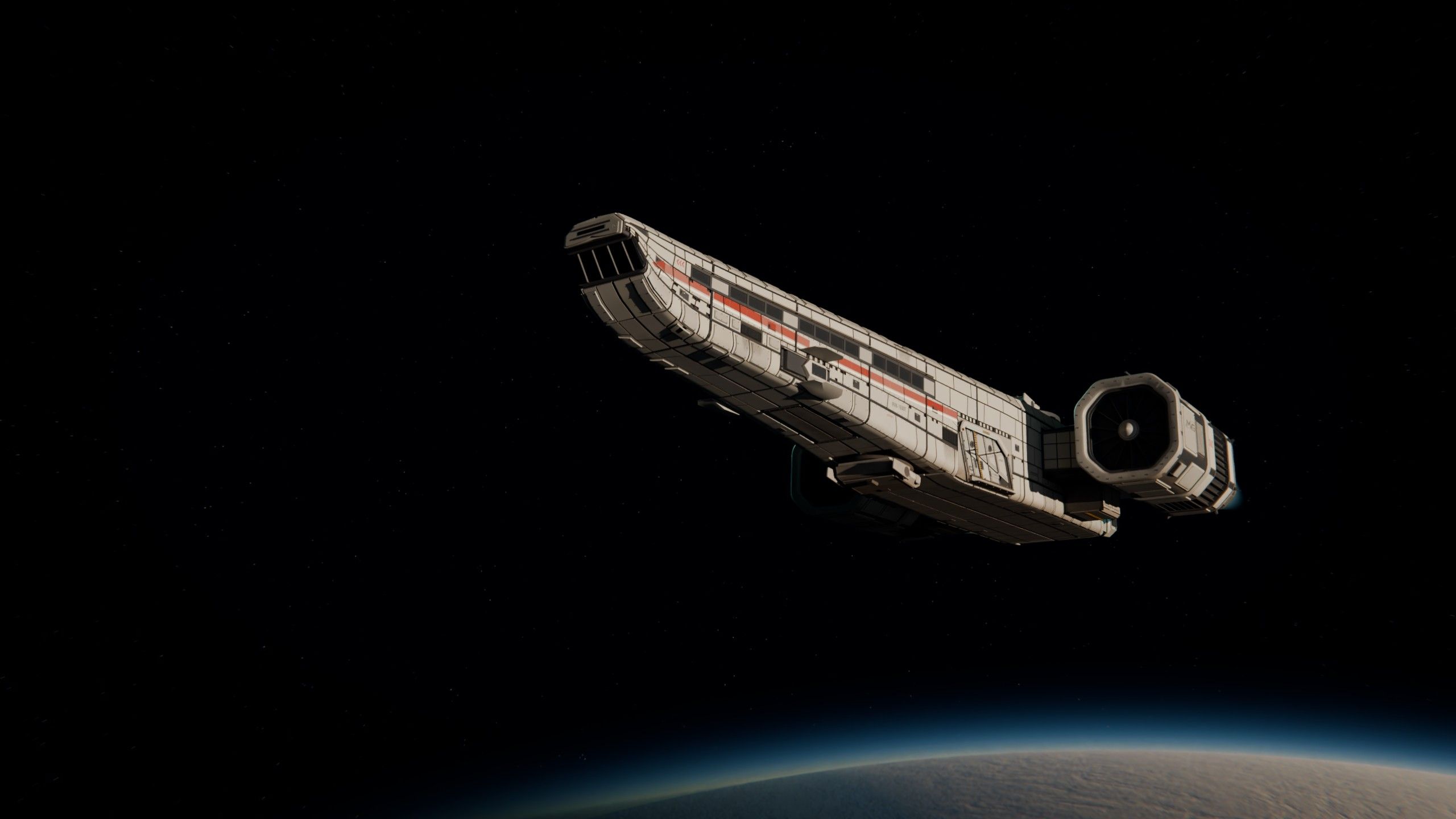
HoldingBuch IProlog
Holding
Dieser Inhalt ist noch nicht übersetzt. Angezeigt wird die Version auf English.
THE VANGUARD · RECOVERY REPORT · CEMENTERIO DE AURA · YEAR 47 E.A., DAY 221
Sealed compartment, pressure retained. Hull stencil: AU-C7. Last recorded closure: Year 1 E.A.
Occupants: nine rest pods. Eight without vital signs. One with vital signs.
Object: auxiliary core of the hull section, powered down, in the exact centre of the compartment. Lens facing the door.
Status: holding.
Destination: the pod with vital signs, to the Arca Custodia. The core, to El Bastión.
Signed: Cpl Y. Osk
Corporal Yannick Osk took eleven minutes to write that report and three hours to regret the last line.
Six hours earlier, the recruit wanted to know why the Vanguard never fires first.
“Because the Colonel says so,” said Osk.
“Right. But why does she say so?”
“Because she’s the Colonel.”
The patrol Tortuga crept along the edge of the Cementerio de Aura with its running lights on and the radar painting scrap in every direction. The Cementerio is what the war of Year 1 left behind: split hulls, containers, the ribs of ships and forty-six years of wreckage going round the star between Kharsis and Ithera. The Vanguard patrols it because someone has to and nobody else wants to.
YANNICK OSK. Corporal in The Vanguard, Tortuga pilot. Eleven years without being late for a shift change, which he considers the only important thing he has done with his life. What you need to know: when something strikes him as serious, he talks more slowly.
The recruit was nineteen, with a helmet too big for her and a habit of asking everything twice. She had been at El Bastión for three weeks. Osk hadn’t learnt her name, because the Colonel had told him not to learn any recruit’s name until their first month was up. If they died before then, the Colonel said, she would learn it herself.
“And if they fire first?” the recruit pressed.
“Then it isn’t first any more.”
“And you just let them?”
“I get out of the way. I’m a pilot. Getting out of the way is what I’m best at.”
The recruit looked out of the canopy. An open container drifted past, turning, with something inside that had once been a chair.
“In training they said there are sentinels out here.”
“Further in.”
“Is it true they’re like the compis? Cores from the Flota?”
“They’re cores. They’re not compis.”
“What’s the difference?”
Osk took his time. He nudged the heading two degrees to avoid a plate that didn’t need avoiding.
“Someone went to fetch the compis,” he said. “Nobody went to fetch the sentinels. They stayed out here going round and round with the last order anyone gave them. Forty-six years ago. Get close and they shoot you, because it’s the last thing they were told to do.”
“That’s sad.”
“It’s scrap that shoots. Save the sadness for another patrol.”
The recruit was quiet for a while. Then she started fiddling with the receiver, which is what every recruit does when bored. She ran through the Vanguard band, the distress band, two cargo bands full of nothing but hiss. She went lower. She went down to bands the Tortuga had come with from the factory and nobody had used since before the Armisticio.
“Stop,” said Osk.
“I haven’t done anything.”
“Go back. Slowly.”
Out of the speaker came a short beep and, behind it, a flat voice that wasn’t a voice so much as a number read out by a machine. Eighty-eight point four. Then nothing.
“What’s that?” asked the recruit.
“Pressure.” Osk checked the time. “Hull pressure, on the old Flota band. It’s a room. Something is saying it’s got a room with air in it.”
“Who?”
“Nobody. It’ll be automatic.”
“How long has it been saying it?”
Osk didn’t answer. He was already turning the Tortuga round.
It took them forty minutes to find it and another twenty to believe it.
It was a piece of hull about forty metres long, blackened, turning once on itself every eleven minutes. Anyone would have missed it. What you couldn’t miss was the stencil that came round on one flank as it turned, in the square letters of the Matriz:
AU-C7.
“AU,” the recruit read.
“Aurora,” said Osk, more slowly than usual.
In the Aurin system everyone knows what the Arca Aurora is, even if they know nothing else. In Year 1, when the Flota split into two sides and started shooting at each other in Ithera’s orbit, the Aurora took fire from both and fell on the planet. It ploughed a furrow several kilometres long that today is called La Cicatriz, with thousands dead inside it. Nobody has ever proved whose shot brought it down. Each house blames the other. What almost nobody knows is that the Aurora, before it fell, was shedding pieces.
“It’s a section of the Arca,” said Osk. “It came loose before the impact.”
“And it’s still got air? After forty-six years?”
“So it says.”
They rigged the field airlock, the pressurised tent the Vanguard carries for rescues and never uses, and sealed it against the hatch. It took Osk a quarter of an hour to talk the door round. It was Matriz, one of the old ones, with the hull controller glowing green. When it finally gave, a breath of air came out so cold that his visor fogged on the inside.
There was frost inside. On the walls, on the ceiling, on the handholds: a thin white coat, as though the room had breathed for a long time and then stopped. Along the back wall stood nine rest pods in a row, crossing-era models, each with its number painted on the lid. Eight had their glass frosted white from the inside and their panels dark. The ninth had a green dot that came on and went off, very slowly.
And in the exact centre of the room, on a floor mount, sat a sphere the size of a head, with scratched plates and a big round lens like a small lighthouse, switched off. The lens was facing the door.
“He’s looking at us,” said the recruit.
“He’s switched off.”
“Then he’s looking at us switched off.”
Osk went over to the pod with the green dot without touching anything. The lid said nine. The panel showed vital signs: slow, low, but steady. Someone had been asleep in there since before there were any Zenith or Nadir.
“There’s one alive,” he said, and his own voice sounded strange inside the helmet.
The recruit looked at the other eight. Then at the sphere.
“And what’s that?”
“An auxiliary core. Hull, going by the plating. Every section on the arks had one. They wrote everything down.”
“What was he doing here?”
Osk looked at the frost. The eight white lids. The ninth. The door they had just opened, which someone had closed from the inside forty-six years ago. The lens, still fixed on it.
“Holding,” he said.
Every first-month recruit knows the protocol, and Osk recited it out loud to this one so she would learn it. Sleepers belong to nobody. The Armisticio de Ithera says so, the Year 12 treaty that ended the war: any sleeper who turns up goes to the Arca Custodia, the neutral ship where CUSTODIA works, the only machine in the system that belongs to no house. Only she can wake them. Only she asks their name.
Pod nine left two hours later in a Pioneers medical shuttle, with escort. The core had no treaty. The core was cargo, and cargo found by a Vanguard patrol goes to El Bastión.
“The Colonel will want to see him,” said Osk.
They put him in a padded transport crate, eleven and a half kilos, and strapped him down in the Tortuga’s hold. Osk wrote the report with his gloves on. When he reached the status box, he hesitated. Then he put what he had seen.
EL NOTARIO. Pirate of the Cementerio. Three red stripes hand-painted on his helmet, like all of his crew. Nobody knows his name and he has never asked anyone theirs. What you need to know: everything he steals, he writes down, and everything he writes down, he collects.
El Notario listened to every band. He did it as a matter of trade, the way a baker smells the oven. He listened to the Vanguard, to The Forge’s salvage crews, to the Guardabosques, to both houses when they insulted each other on channels they thought were closed. That afternoon he heard a Vanguard corporal call for a medical shuttle for a pod and, in the next sentence, use the word core.
“Sleepers don’t sell,” he told his lads. “Cores do.”
The Revenant was called Conforme. It was a military hull from before the war, from when the Flota still had its own security, bought three times, stolen twice and modified so often that nothing stock was left but the noise of the nacelles. It slid out from behind a wreck with its turrets deployed just as the Vanguard Tortuga was leaving the Cementerio for Ithera.
“Good afternoon, Corporal,” said El Notario on the open channel. “Leave the ore on the ground and your boots on.”
There was a pause.
“We’re not carrying ore,” said Osk.
“Figure of speech. You’re carrying a crate. The crate, on the ramp.”
“This is a patrol of The Vanguard.”
“I know. Which is how I know you won’t fire first. And I, if you force me, have no wish to fire second.”
Osk counted the Revenant’s turrets. He counted his own, which came to none. He looked at the recruit, who had gone white, and lowered the ramp.
Three of them came aboard. Three red stripes on every helmet. They unstrapped the crate without hurrying and without looking inside. The last one, a short man with a black-covered notebook under his arm, stayed on the ramp, wrote something, tore out the page and handed it to Osk.
RECEIVED IN GOOD ORDER from the patrol of The Vanguard, Cementerio de Aura, Year 47 E.A., day 221: one (1) padded transport crate, contents of Flota origin, unopened.
The ship is returned.
Signed: El Notario
“You’ll get the ship back,” said El Notario. He waited a second. “Maybe.”
And off he went down the ramp, chuckling quietly, like a man who has told a joke only he finds funny.
In the hold of the Conforme, one of his lads gave the crate a gentle kick to see if it sounded like anything.
“What is it, boss?”
“A core from the Flota.”
“Worth anything?”
“Worth whatever they’ll pay for him.” El Notario sat on a drum and opened the notebook on his knees. “There are five in the whole system working for the Gremios, and none of them is for sale. This would be the sixth. The sixth of something that isn’t for sale, son, is the most expensive thing there is.”
“Isn’t he the Vanguard’s, though? They found him.”
“They found him. They didn’t keep him.” El Notario licked the tip of his pencil. “What gets thrown away still has an owner. Us. And what doesn’t get kept, likewise.”
“But they hadn’t thrown him away.”
“They left him forty-six years spinning round the Cementerio with his light off.” El Notario wrote a line, slowly, in his small, neat hand. “In my line of work, that’s called throwing away.”
The Tortuga was left alone by the wreck with an empty hold. The recruit was breathing very fast.
“Aren’t we going to do anything?”
Osk read the receipt twice. Then he took out the report and read the status box.
“We’re already doing it,” he said. “We’re holding.”
At five in the afternoon, in the hold of a Revenant that belonged to nobody, among grease drums and parts with no manifest, a padded crate said eighty-eight point four on a band nobody listened to.
It had been saying it for forty-six years. Nobody had ever answered.
What was inside the crate, El Notario didn’t know yet, nor did the Vanguard, nor the two houses that would very soon want to buy it. The person in pod nine knew. But that person had been asleep for forty-seven years, and would not wake until the next day.
Inhalt des Buches
- PrologHolding
- Kapitel 1No Prior Record
- Kapitel 2We're Not Your Friends
- Kapitel 3Received
- Kapitel 4Unnumbered Axiom
- Kapitel 5One Alive
- Kapitel 6The Wall
- Kapitel 7What Nobody Wanted
- Kapitel 8Measured, Not Derived
- Kapitel 9Red Ribbon
- Kapitel 10Lelo
- Kapitel 11Dock Seven
- Kapitel 12Twelve Minutes
- Kapitel 13The Names
- EpilogChoose Your House
Leseeinstellungen
Deine Einstellungen und deine Leseposition werden nur in diesem Browser gespeichert.
